AI Teacher for Bangladesh
Curriculum-aligned AI teacher scaling to 200K+ students with behavioral analytics across rural and urban demographics.
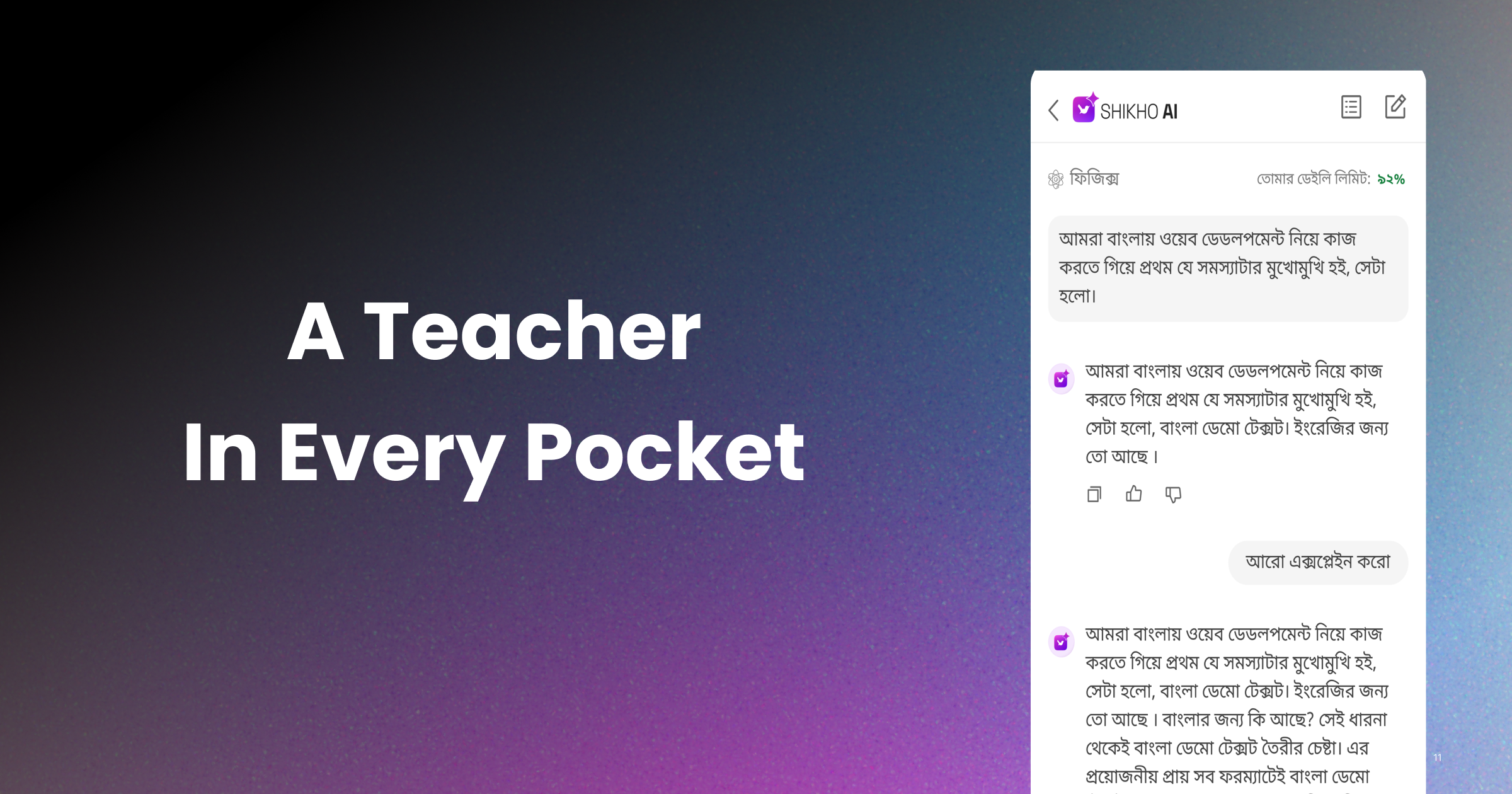
Personalized Learning Scarcity: Creating an AI Teacher for 40 Million Students
In Bangladesh, 40 million students face a critical gap: overcrowded classrooms with 1:60 teacher-to-student ratios, curriculum misaligned AI tools, and the stigma of asking questions. At Shikho, we built an AI teacher that understands Bangladesh’s National Curriculum, speaks Bangla, and gives every student a patient tutor available 24/7.
The Challenge
Five barriers prevented students from accessing quality personalized education:
- Insufficient Individual Attention — Teacher ratios exceeding 1:60 made personal help impossible
- Curriculum Misalignment — Generic AI like ChatGPT didn’t align with Bangladesh’s National Curriculum
- Missing Step-by-Step Explanations — Students needed adaptive explanations, not generic responses
- Mathematical Notation Problems — STEM subjects required precise Bangla formatting international tools couldn’t deliver
- Stigma Around Asking Questions — Embarrassment in crowded classrooms created persistent learning gaps
The Solution
I led development of Shikho AI with four core components:
Retrieval-Augmented Generation (RAG) — Curriculum-aligned responses pulling from official Bangladesh National Curriculum textbooks
Subject-Specific AI Models — Dedicated AI “heads” for Physics, Math, Chemistry, Biology, and English with specialized reasoning
Curriculum Boundary Controls — Guardrails ensuring responses match exam formats and grade-appropriate difficulty
Human-in-the-Loop Quality Control — Student feedback system flagging poor responses for continuous improvement

The Result at a Glance
What happened when students got access to an AI teacher built for their curriculum
These weren’t vanity metrics. The 4,000 daily active users represented students choosing to return to Shikho AI day after day—a strong signal that we had built something students actually needed.
Validating the Approach: Beta Results
Before committing to a full-scale launch, we ran a closed beta with 2,000 students to validate product-market fit. The question wasn’t whether students would try Shikho AI—it was whether they would keep using it.
Beta Validation: 2,000 Students
Would students keep coming back? The beta answered that question.
The 1,611 return users—over 80% retention—gave us confidence to scale. Students weren’t just experimenting; they were building a habit. The median of 3 sessions per user told us that once a student asked their first question, they came back with more.
Impact at Scale: Reaching Beyond the City
When we opened Shikho AI to the public, something unexpected happened. Rather than serving primarily urban students with better resources, we saw strong adoption from rural areas where access to quality tutoring is most limited.
Where Our Students Come From
Rural Penetration Success
Unlike typical edtech platforms, Shikho AI achieved 62.7% rural user penetration, democratizing access beyond major cities.
This 62.7% rural penetration rate—roughly 4× the industry standard for edtech in Bangladesh—proved a critical point: AI-powered education doesn’t need to flow from cities outward. When built with local language and curriculum alignment, it can reach students in remote areas directly.
How Students Actually Use Shikho AI
The behavioral data revealed patterns we hadn’t anticipated. We expected students to use Shikho AI for deep study sessions. Instead, the dominant use case was something simpler—and more revealing.
What Students Ask Shikho AI
Session types reveal how students actually learn
61.2% quick clarification validates our hypothesis: students need a safe space to ask questions.
The 61.2% quick clarification rate confirmed our core hypothesis: students need a stigma-free space to ask questions they wouldn’t raise in a classroom of 60 peers. In a traditional classroom, admitting confusion carries social risk. With Shikho AI, it’s frictionless.
The 17.3% deep exploration rate, while lower than we’d like, showed that a meaningful minority of students were using Shikho AI for sustained study. This became a product opportunity: how do we guide more students from quick questions toward deeper engagement?
Subject-Specific Patterns
As we analyzed usage by subject, clear patterns emerged. Different subjects drove fundamentally different types of interaction with the AI:
How Each Subject Drives Different Use
Subject-specific interaction patterns that shaped our AI models
Physics stood out immediately: 31.7% of sessions involved problem-solving, the highest among all subjects. This made sense—physics problems require multi-step reasoning that students can’t easily look up in a textbook. Chemistry showed more balanced use, with students asking both concept questions and working through problems. Biology and English served as foundation builders, with over 86% of sessions focused on concept explanation at a beginner level.
These patterns informed how we tuned each subject’s AI model. Physics needed stronger reasoning capabilities. Biology needed clearer, simpler explanations. One model didn’t fit all.
The Gap That Remains
The most actionable insight from our data wasn’t about overall usage—it was about the performance difference between urban and rural students when tackling complex problems.
The Urban-Rural Performance Gap
How urban and rural students differ in problem-solving engagement
Problem-solving engagement comparison
Physics Problem-Solving
+9.8 urban advantageChemistry Problem-Solving
+15.6 urban advantageApplication-Level Cognition
+5.1 urban advantage+15.7 point gap in chemistry reveals opportunity for targeted rural scaffolding.
The 15.7-point gap in chemistry problem-solving between urban and rural students was the largest we measured. This wasn’t a reflection of ability—it was a reflection of preparation. Rural students, who often attend schools with fewer resources and less experienced teachers, arrive at complex problems with less foundational confidence.
This data point became one of the most important inputs to our product roadmap. It told us that simply providing access wasn’t enough. We needed to build targeted scaffolding—additional support layers that help rural students bridge from basic understanding to confident problem-solving.
Strategic Takeaways
The behavioral analysis from these dashboards directly shaped three priorities on our roadmap:
Close the Urban-Rural Gap — Rural students need targeted support tools to build confidence in complex problem-solving, especially in STEM subjects where the urban advantage is most pronounced.
Encourage Deep Exploration — Only 17.3% of sessions involve deep dives into topics. We’re building guided learning paths that gently push students beyond quick clarifications toward sustained engagement.
Cross-Subject Integration — Just 0.7% of sessions link subjects together. We’re developing tools to show connections between Physics, Math, and Chemistry concepts, helping students see knowledge as interconnected rather than siloed.
Transforming Education
Shikho AI proves that AI can reach beyond traditional edtech markets. A student in a rural classroom with 60 peers now has a personalized tutor available 24/7. The data reveals clear opportunities—particularly in closing the urban-rural gap—but the foundation is solid: we have built an AI teacher that understands Bangladeshi students and helps them learn in ways that were previously impossible.
More Projects

Ads Pipeline Implementation
End-to-end ads data pipeline and mobile attribution system that unified Facebook Ads, Google Ads, and in-app event tracking into a single BI layer for campaign optimization.

In-House CRM Transformation
Led the shift from a third-party CRM to a custom in-house sales platform for Shikho's 200-agent telesales team, improving data access, customization, and cost control.

Installment Plan System
Flexible installment-based course purchasing that expanded access to education for students who could not pay upfront.